What Is Non-Emergency Stretcher Transport — and Do You Need It?

Updated: Jun 19
Aurevia Patient Transfers | Toronto & GTA
Most people only discover that stretcher transport exists at the exact moment they need it. A parent is being discharged from hospital and can't sit up. A spouse has a surgery follow-up that's three weeks away and can't manage a regular car. Someone calls a taxi, realizes quickly that won't work, and starts searching for something else — often without knowing what to call it.
This article explains what non-emergency stretcher transport is, who it's for, how it differs from an ambulance, and how to tell whether it's the right option for your situation.

What it is
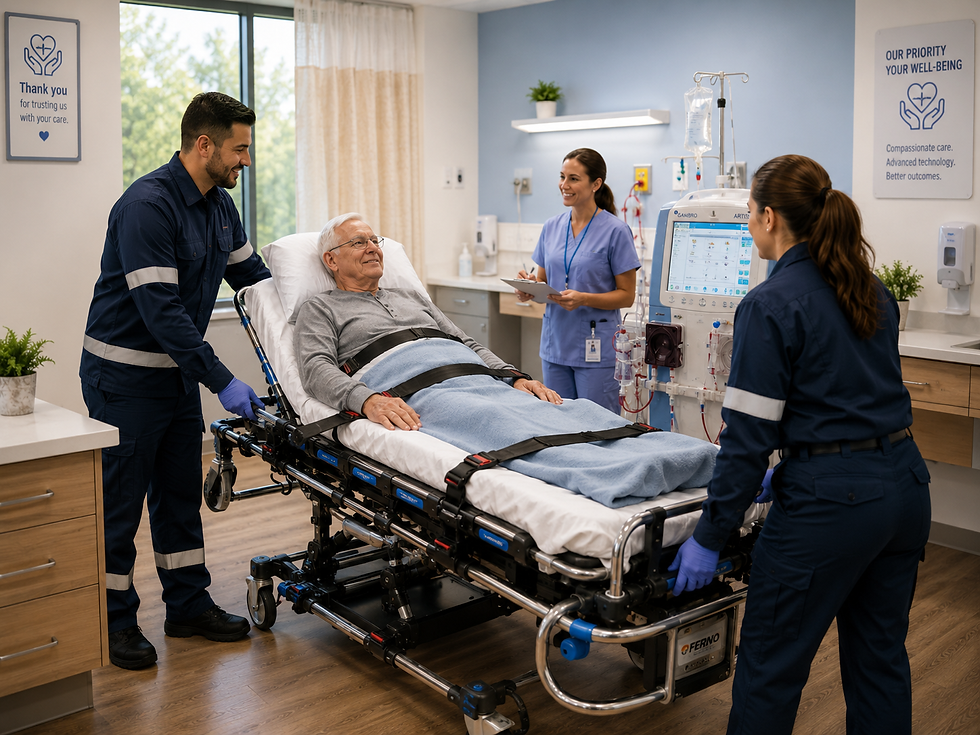
Non-emergency stretcher transport is a scheduled medical transportation service for people who need to travel lying down. The patient rides on a stretcher inside a purpose-built vehicle, attended by two trained crew members for the full duration of the trip.
It covers the gap between the emergency ambulance service and regular transportation. An ambulance is designed for medical crises — active emergencies requiring paramedic intervention during transit. A standard car, taxi, or ride-share assumes the passenger can sit upright comfortably. Stretcher transport fills the space between those two: for patients who are medically stable, but can't safely or comfortably travel in a seated position.
The service is pre-scheduled. You book in advance, confirm the pickup window, and the crew arrives prepared for your specific situation — access details, positioning requirements, and any equipment travelling with the patient.
Who uses it
The circumstances that lead people to stretcher transport are more varied than most expect.
This is the most common scenario. A patient is being discharged from hospital but isn't cleared to sit upright — often following abdominal, back, or hip surgery, or after a period in ICU or surgical recovery. The hospital expects the family to arrange transport; not everyone knows what kind.
Dialysis patients who require treatment three times a week and can't sit for the trip. Cancer patients travelling to and from chemotherapy or radiation when fatigue or positioning requirements make a standard vehicle inappropriate. Patients in ongoing recovery from a procedure or illness.
Moving a family member from hospital to a long-term care home, retirement residence, or rehabilitation centre. Or between two facilities when their medical needs change.
Palliative and end-of-life care.
When a person is in the later stages of illness and needs to travel — to a hospice, to a specialist, or home — stretcher transport allows them to do so with dignity and without the discomfort of sitting upright.
After surgery, before full recovery.
Many patients are discharged in a condition where sitting is technically possible but not advisable or comfortable for an extended trip. Stretcher transport gives them an option that doesn't compromise their recovery.
Why it makes a difference
Professional stretcher transport isn't just about having the right vehicle. It's about safe handling, proper positioning throughout the trip, and coordination at both ends — so families don't have to manage the logistics themselves or risk injury trying to improvise a transfer.
For patients recovering from surgery or travelling with significant mobility limitations, the difference between a professional transfer and a makeshift one is real. The crew knows how to move someone safely through doorways, stairwells, and into a vehicle designed for the purpose. The patient arrives at their destination without being put through something unnecessary.
For families, it means being there as family — not as the person responsible for figuring out how to lift someone from a hospital bed into a car without hurting them or themselves.
If you're weighing stretcher transport against other options, we've put together a more detailed comparison in a separate article — including when a wheelchair-accessible vehicle may be sufficient and when it isn't.
How it differs from an ambulance
This comes up often enough that it's worth addressing directly.
An ambulance is staffed by paramedics trained and equipped for medical emergencies. The vehicle carries advanced medical equipment for on-the-road intervention. Ambulances are dispatched for emergencies — cardiac events, accidents, acute medical crises — and are generally not the appropriate or available option for planned, non-urgent transport.
Non-emergency stretcher transport carries trained attendants, not paramedics. The vehicle is built for safe, comfortable transport of a patient lying flat — the right clearance, suspension, loading systems, and securing equipment — but it is not equipped for emergency medical intervention. That distinction matters: stretcher transport is for patients who are stable and don't need emergency care during transit. If someone's condition is uncertain or they may deteriorate en route, a paramedic-staffed service is the right call.
For the majority of hospital discharges, facility transfers, and pre-scheduled medical appointments, the patient is stable. Non-emergency stretcher transport is both appropriate and significantly more accessible — it can be booked in advance, fitted to your schedule, and doesn't require emergency dispatch.
When it's the right option
You're likely looking at stretcher transport if your loved one:
Has been told by their care team that they need to remain lying down or can't sit upright for an extended period
Is recovering from surgery involving the abdomen, back, hip, or another area that makes sitting painful or risky
Has a mobility condition that means they travel by stretcher routinely
Needs to get to a recurring appointment (dialysis, treatment) and can no longer manage in a regular vehicle
Is moving between a hospital and another care facility and requires bed-to-bed handling
If you're not sure whether stretcher transport is medically appropriate, ask the nursing team or discharge planner. They can tell you what level of transport the patient's condition calls for. That's their assessment to make — a good transport provider will want to know what the care team recommends.
What the service actually includes
Two crew members travel with every patient for the full trip. One attendant isn't sufficient to safely move a person on a stretcher through a building, into a vehicle, and to their destination — it takes two, and both are trained in patient handling and movement through confined spaces.
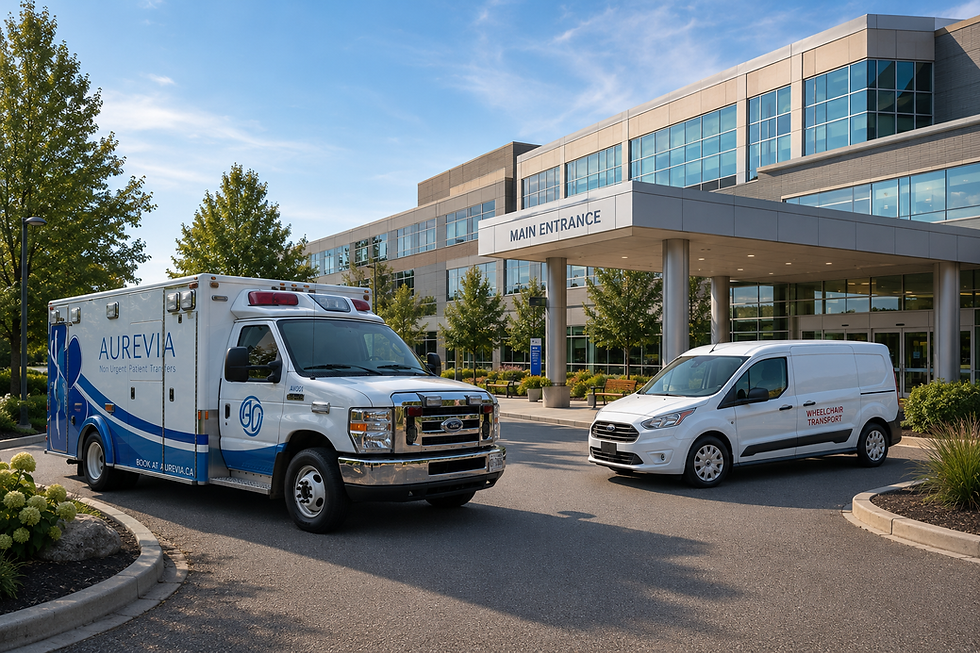
The vehicle is purpose-built for stretcher transport: the loading system, interior clearance, suspension, and patient restraints are designed for someone travelling flat, not as an afterthought in a converted van.
Before arrival, the crew reviews access details for both pickup and drop-off locations. Stairs, narrow hallways, elevators, building entry — anything that could affect how the transfer goes. At Aurevia, stair access is included in every booking, not treated as a separate charge.
One family member can travel alongside the patient at no additional cost. For most families, that matters — particularly on the first trip, when everything is unfamiliar.
Booking stretcher transport in Toronto
When you contact Aurevia, we'll ask a few straightforward questions: the pickup and drop-off addresses, access details at each location, your loved one's mobility and positioning needs, and the date and time window you're working with. We'll provide a quote. Nothing is added at the door.
If you're not certain whether stretcher transport is the right service — whether your loved one's situation calls for this or something different — we're happy to talk through it. Sometimes the answer is stretcher transport. Sometimes wheelchair-accessible transport is sufficient. We'd rather help you figure that out than book a service that isn't the right fit.
Phone: 437-870-8090 | Monday to Sunday, 8am to 8pm
Aurevia Patient Transfers provides pre-scheduled, non-emergency stretcher transportation across Toronto and the Greater Toronto Area — hospital discharges, medical appointments, dialysis, and facility-to-facility transfers.
Comments