
Stretcher Transportation Services — Toronto & GTA
Non-emergency stretcher transport for people who can't travel safely in a standard vehicle. Whether it's a hospital discharge, an ongoing treatment, a transfer between facilities, or a long trip across the province — we handle it with two trained attendants, proper equipment, and a confirmed arrival window.
Every trip is pre-scheduled. Every crew is trained. Nothing is improvised.
TWO TRAINED ATTENDANTS
BED-TO-BED SERVICE
CONFIRMED PICKUP WINDOW
FIXED, ALL-INCLUSIVE PRICING
FACILITY COORDINATION
When Transportation Becomes a Concern
Most people don't think about stretcher transport until they need it.
A discharge happens faster than expected. A loved one's condition changes. A procedure leaves someone unable to sit safely in a car.
Suddenly there's a gap between what's needed and what's available.
We fill that gap.


What Stays the Same on Every Transfer
Regardless of the service type or the distance, the crew and the process don't change.
Two trained attendants arrive in every vehicle. Equipment is set up before they reach the bedside, not at it. Your loved one is transferred using controlled, low-risk movement techniques. The stretcher is anchored with certified securement systems. And the crew doesn't leave the destination until handover is confirmed.
There's no "basic" option where you get one person instead of two, or where the crew skips documentation because it's a short trip. The standard is the standard.
More Situations We Can Help With
Not every situation fits a standard service category. Some situations are in-between — after a procedure, before a long journey, when the person simply can't do it alone. If you're not sure whether we can help, tell us what you're dealing with and we'll figure it out.
We assist :
-
After surgery when you’re not allowed to take a taxi
-
When no family member is available to assist or drive
-
When stairs or tight spaces are involved
-
When a patient must remain lying flat during transport
-
When extra time and patience are needed during the transfer
-
When returning home after sedation, anesthesia, or a procedure (colonoscopy, cataract surgery, oral surgery)
-
When ongoing treatments require reliable, recurring transportation
-
When traveling between cities for care
After-Procedure & Sedation Transport
Safe return home after outpatient surgery, colonoscopy, cataract surgery, dental sedation, cosmetic procedures, or any same-day appointment where you can't take a taxi home.
Recurring Medical Visits
Dialysis three times a week, chemotherapy cycles, radiation courses — recurring appointments get a standing schedule instead of a new booking every time.
Long-Distance Transport
Stretcher transport between cities across Southern Ontario, including Ottawa to Toronto.
Airport & Travel Transfers
Stretcher transport to and from Toronto Pearson for patients traveling for care or returning home after treatment.
Palliative & Comfort-Focused Transport
Gentle, dignified transport focused on comfort and family presence during sensitive transitions..
Bariatric & Complex Cases
Bariatric stretcher transport with the equipment and crew needed for safe handling. Every case is reviewed individually before booking.
If you’re unsure whether this service is right for your situation, we’ll guide you.
Every transfer is reviewed individually to ensure it’s planned safely and appropriately.
When Stairs Are Part of the Transfer
Many homes and older buildings don't have elevators. When a patient can't bear weight or walk unaided, getting them safely through a staircase requires proper technique and two trained people — not improvisation.
Situations where stair access matters:
-
Getting a patient down stairs after hospital discharge
-
Bringing someone safely into a home with no elevator
-
Narrow staircases in older buildings
-
Limited hallway or entrance space
-
When the patient cannot walk or bear weight
-
When family members are unable to assist safely
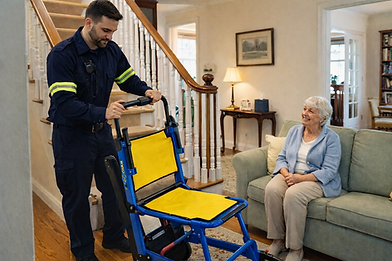
HOW AUREVIA HANDLES IT
Two crew members coordinate every step — no rushing. We review access details in advance when possible, and we use positioning techniques designed for confined spaces. The goal is to keep the patient stable and comfortable through the entire entry or exit.
Unsure If Stair Access Will Be an Issue?
Tell us about the layout — we’ll review it and guide you on the safest approach.