Understanding Bed-to-Bed Stretcher Service for Toronto Families

Updated: Jul 20
Aurevia Patient Transfers | Toronto & GTA
When you call around for stretcher transport, almost every provider will tell you they offer "bed-to-bed" service. It sounds like a standard feature, so it's easy to assume every quote includes the same thing. It doesn't. The term gets used loosely, and what it actually covers varies a lot between providers — which matters a great deal once a crew is standing in your loved one's hospital room or bedroom.
This article explains what bed-to-bed service actually means, what should be included in it, and why the difference matters for a transfer that involves a person who can't move on their own.

What "bed-to-bed" is supposed to mean
The name describes where the service starts and ends: at the bed your loved one is currently in, and at the bed they're going to — not the curb outside, not the building lobby, not the back of the vehicle.
That sounds obvious. But a lot of non-emergency transport is priced and structured around the vehicle portion of the trip — the driving — with everything before and after treated as the customer's problem to solve. A wheelchair van or an ambulette can get someone from one address to another. Getting a person who can't sit up or stand on their own out of an actual bed, through an actual hallway, and into an actual bed at the other end is a different job, and it's the job a stretcher transfer needs to do well.
What's actually involved in a true bed-to-bed transfer
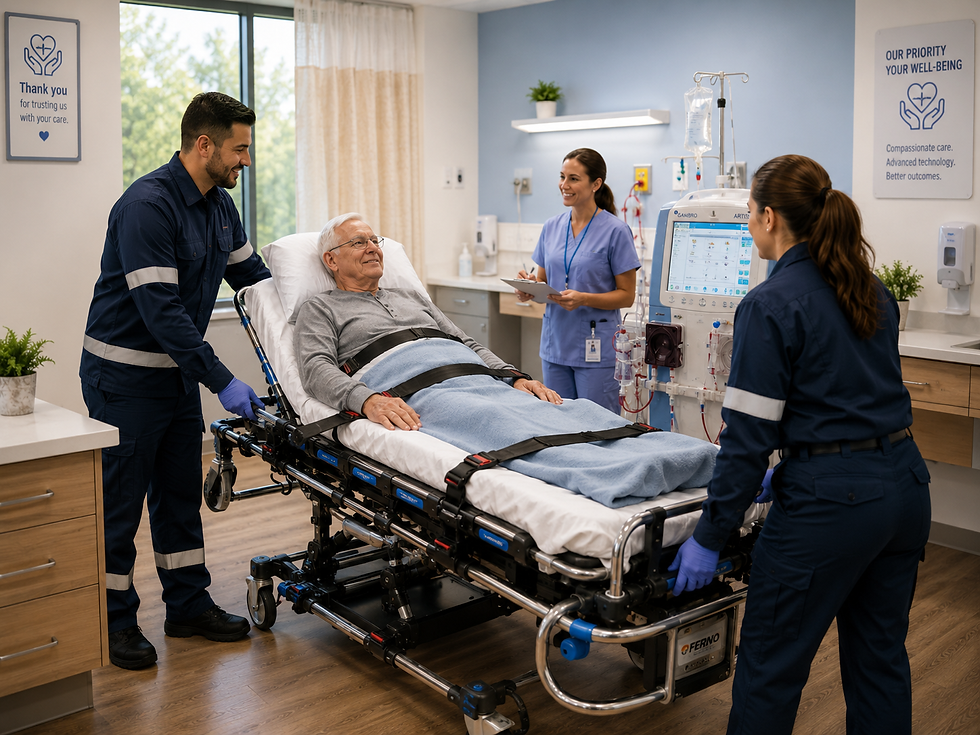
Moving someone safely off the bed they're in.
This is a controlled lift and transfer, not a slide or a drag. It takes technique, and it takes two people — one attendant working alone with someone who can't support their own weight isn't a safe transfer, for the patient or for the attendant.
Getting through the building.
Hospital rooms, narrow condo hallways, stairwells, tight doorways, elevators that may or may not be working. Every location is different, and a crew that hasn't planned for what's actually between the two beds will lose time and create avoidable stress once they're on-site.
Positioning and comfort during the move itself.
Someone lying flat is more aware of every bump, turn, and incline than they would be sitting upright. Crew trained in patient handling know how to keep movement smooth and how to communicate with the person being moved, not just transport them.
Getting them settled at the other end.
The transfer isn't finished when the vehicle stops moving. Getting a person safely off the stretcher and into the bed at the destination — positioned the way the receiving nurse or family member needs them to be — is the other half of "bed-to-bed."
At Aurevia, this is the standard for every booking, not an upgraded tier. Two trained crew members handle the full transfer at both ends. Stair access is included in the base price, because stairs come up in most residential pickups and shouldn't turn into a surprise charge or a reason a crew can't complete the job.
Questions worth asking before you assume "bed-to-bed" means the same thing everywhere
Does the quote include getting from the bed to the vehicle, or just the drive? Some providers price the trip itself and treat the transfer at each end as a separate, sometimes additional, service.
How many crew members handle the physical transfer? One attendant is not enough to move someone safely. If a provider sends one person and expects a family member to help lift, that's worth knowing before the day of the move.
Is stair or elevator access included, or billed separately? Ask directly. It's a common point where quotes that looked similar end up very different.
Will the crew coordinate with nursing staff or family at both ends? A transfer that starts with a clean handover from a nurse and ends with the patient properly settled — not just deposited — is part of what bed-to-bed should mean.
When this matters most
Bed-to-bed handling matters in any transfer, but it matters especially in a few situations: hospital discharges where your loved one isn't cleared to sit upright, moves between a hospital and a long-term care or rehab facility, and any transfer where the person being moved has limited ability to assist with their own positioning. In all of these, the quality of the transfer at each end — not just the drive in between — is what determines whether the day goes smoothly or becomes another source of stress.
Booking with Aurevia
When you call Aurevia, we'll ask a few straightforward questions — pickup and drop-off addresses, your loved one's mobility and positioning needs, preferred date and timing, and whether there are any access considerations at either location (stairs, elevators, building entry).
From there, we provide a complete quote. There are no charges added at the door.
Phone: 437-870-8090 | Monday to Sunday, 8am to 8pm
Aurevia Patient Transfers provides pre-scheduled, non-emergency stretcher transportation across Toronto and the Greater Toronto Area — hospital discharges, medical appointments, and facility-to-facility transfers.
Comments