How Much Does Non-Emergency Stretcher Transport Cost in the GTA — And What You're Actually Paying For

Updated: Jun 19
Aurevia Patient Transfers | Toronto & GTA
Most people arrange stretcher transport once, maybe twice in their lives — usually in the middle of something stressful. A discharge is happening faster than expected. An appointment can't wait. They find out this service exists, call a couple of providers, get quotes that don't match, and have no framework to understand why.
This article is for those people. We'll walk through exactly how stretcher transport is priced, what each element of a quote actually represents, and what to ask when comparing providers. By the end, a quote shouldn't feel like a black box.

What Are Non-Urgent Patient Transfers?
Non-urgent patient transfers involve moving patients who do not need immediate emergency care but require assistance due to medical conditions, mobility issues, or specialized equipment. These transfers can include rides to:
Routine medical appointments
Rehabilitation centers
Long-term care facilities
Diagnostic testing locations
Unlike emergency ambulance services, these transfers are planned in advance and focus on patient comfort and safety.
What goes into a stretcher transport quote
Where you are relative to the provider's base.
Every stretcher transport company operates from a physical location. The crew has to get to you before the trip even starts. Providers price this into their base rate, so a pickup close to their base costs less than one far away. When you get a quote that seems wildly high, this is often why — the provider has to send a crew an hour out to do a 10-minute trip. It's worth asking where a company is based if they're quoting you significantly more than someone else.
How far you're traveling.
On top of the base rate, there's a per-kilometre charge for the actual distance of the trip. Longer trip, higher cost. Straightforward.
Your specific situation.
Most trips are standard. Some aren't. Bariatric transport, for instance, often requires additional crew and specialized equipment — and that's priced accordingly. Same with isolation precautions (when the vehicle needs to be thoroughly sanitized between patients), airport transfers (which involve documentation requirements and specific access protocols that take real time to manage), and long-haul trips that go well beyond the GTA.
How the return trip is handled. If your loved one only needs transport in one direction, that's a one-way quote and the return isn't part of it. If they need to come home the same day, how the return is arranged also affects the price.
What you're getting with every booking
Stretcher transport is a different category of service from a taxi, a rideshare, or even a wheelchair van. Understanding what's actually involved makes the quote easier to read.
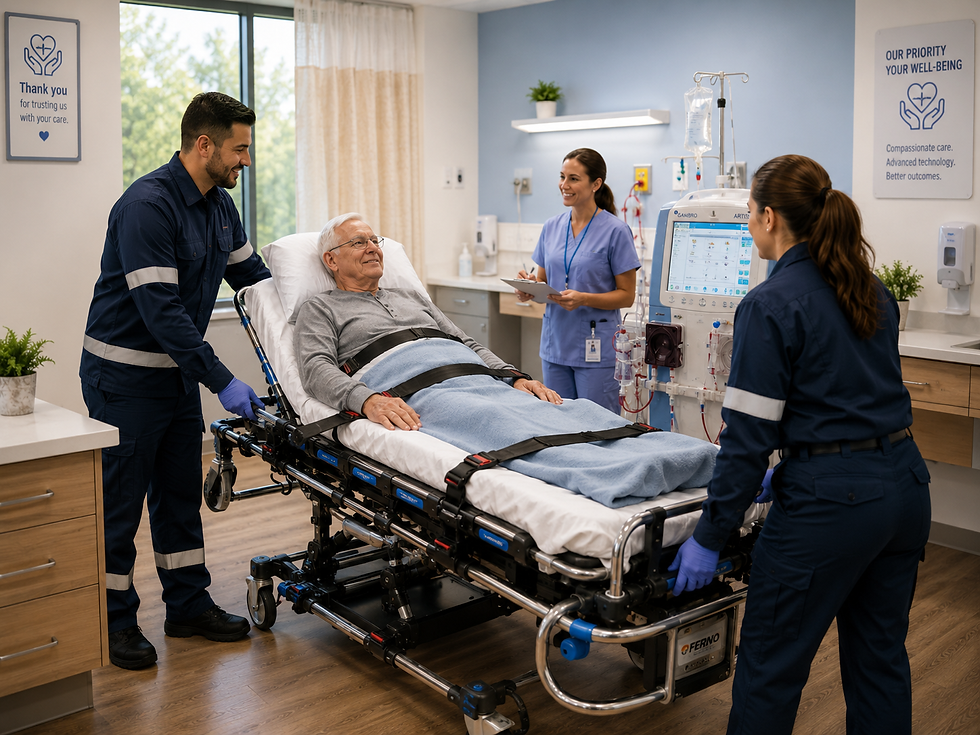
Two trained crew members. Every stretcher transfer requires two attendants — one isn't enough to move a person safely from a bed, through a building, and into a vehicle. Both crew members are trained in patient handling, positioning, and safe movement through confined spaces like stairwells and narrow hallways. They stay with your loved one from pickup to drop-off.
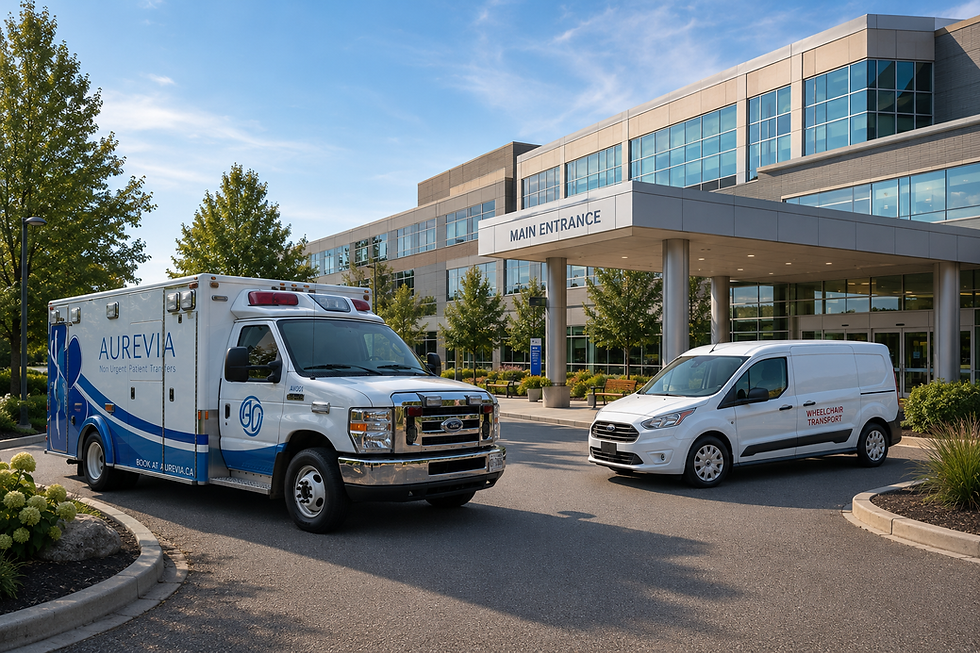
A purpose-built vehicle. Stretcher transport vehicles are built for this — the clearance, suspension, loading systems, and patient restraints required to move someone lying flat safely and comfortably. A converted van isn't the same thing.
Preparation before arrival. Before the crew leaves the building, we review access details for both locations, coordinate with any involved facilities, and confirm timing windows. Surprises at the door — a locked entrance, a floor change, an elevator that's out — create stress for everyone. We try to eliminate them ahead of time.
Insurance and proper coverage. Commercial medical transport insurance and workplace injury coverage for all crew members are built into every booking. Patient health information is handled in line with Ontario's privacy regulations. These aren't extras — they're baseline requirements for operating responsibly.
Coordination on both ends. For facility transfers or hospital discharges, we communicate directly with the sending and receiving teams. Families shouldn't have to be the relay point between a nurse and a transport crew.

Questions worth asking any provider before you book
Quotes for stretcher transport can vary between providers — sometimes significantly — for the same trip. A few questions help you understand what you're actually comparing.
Is stair access included? Stairs come up in the vast majority of residential pickups. If a service positions itself as bed-to-bed, it should include whatever comes between the beds. We include stair access in our base price. It's worth confirming whether others do.
Is a family escort included? We include one accompanying family member at no additional cost. Ask whether this is standard or an add-on.
Is the quote all-in? Ask directly whether there are any charges that might be added beyond what's quoted. Isolation precautions, equipment, fees for airport transfers — legitimate costs, but they should be disclosed upfront, not appear on the invoice afterward.
Where is the provider based? If a crew has to travel a significant distance to reach your pickup, that cost is typically built into the quote. Knowing where a provider operates from helps explain rate differences between quotes.
Will insurance or government coverage help with the cost?
It depends on your situation — and it's always worth checking before assuming you're on your own.
Private health insurance is the most common source of coverage for this type of transport. Many extended health plans include a medical transportation benefit, and some do cover stretcher transport, at least in part. Coverage varies significantly between plans, so it's worth calling your insurer directly with the specifics of your trip. Ask whether non-emergency stretcher transport to a medical appointment or hospital discharge qualifies under your plan.
Ontario's government health coverage (OHIP) covers emergency ambulance transport when there's an immediate medical need. For pre-scheduled, non-emergency transport — which is what stretcher transport typically is — it generally doesn't apply. There are some exceptions: certain treatment programs, such as those for dialysis or cancer care, may have transportation support built in at the facility level. If your loved one is enrolled in one of those programs, ask their care coordinator whether any transportation funding is available.
Employer benefits and group plans are another avenue worth exploring if applicable. Some workplace benefit packages include medical transportation coverage that extends to family members.
The honest answer is that many families do pay out of pocket for this service. But the coverage landscape is varied enough that a quick call to your insurer — with the date, trip details, and reason for transport — is always worth making first.
Typical Price Ranges in Ontario
Non-urgent patient transfer costs vary widely depending on the provider and service level. Here are some general estimates:
Basic wheelchair van service: $50 to $200 for short trips within city limits.
Ambulance transfer without emergency or paramedics: $220 to $600 for local trips, with rates increasing for longer distances.
Transfers with medical staff: $400 to $1,000 or more, depending on care level and distance.
For example, a 20-kilometer transfer using a wheelchair-accessible van might cost around $150, while the same distance with paramedic support could exceed $500.
Getting a quote
When you call Aurevia, we'll ask a few straightforward questions — pickup and drop-off addresses, your loved one's mobility and positioning needs, preferred date and timing, and whether there are any access considerations at either location (stairs, elevators, building entry).
From there, we provide a complete quote. There are no charges added at the door.
Phone: 437-870-8090 | Monday to Sunday, 8am to 8pm
Aurevia Patient Transfers provides pre-scheduled, non-emergency stretcher transportation across Toronto and the Greater Toronto Area — hospital discharges, medical appointments, and facility-to-facility transfers.

Comments