Essential Tips for Safely Transporting Your Elderly Loved One

Updated: Jun 19
Aurevia Patient Transfers | Toronto & GTA
A routine drive to a doctor's appointment, a family visit, or an errand doesn't feel like it needs special planning — until a fall getting into the car, a dizzy spell after standing up too fast, or a painful transfer turns a simple trip into the thing everyone's worried about for the rest of the day. Most of the risk in transporting an elderly loved one isn't in the driving. It's in the moments right before and after — getting in, getting out, and everything in between.
Here's what actually helps, and how to know when a standard vehicle isn't the right tool for the job anymore.
Before you leave
Build in more time than feels necessary. Rushing is where most transfer accidents happen — a quick grab at an arm, a fast pivot toward the car seat, a "let's just get you in" moment that skips a step. Plan the trip assuming the getting-in-and-out part will take longer than the drive.
Check the path, not just the destination. Look at the route from the door to the vehicle. Uneven pavement, a step down to the driveway, ice in winter — these are the moments that matter, not the highway.
Bring mobility aids, even for a "quick" trip. A cane or walker left at home because the trip seemed short is the one that's needed when your loved one has to navigate an unexpected set of stairs or a longer walk than planned at the destination.
Getting in and out of the vehicle safely
Let them set the pace.
Standing up, turning, and lowering into a seat takes longer and requires more balance than most people remember once they're used to moving quickly themselves. Resist the urge to hurry the sequence.
Watch for dizziness after standing.
Many older adults experience a brief drop in blood pressure when they stand up, especially after sitting for a while. A pause before walking to the car — a few seconds to steady — prevents a lot of falls.
Support from the right position.
Standing slightly to the side and below, rather than pulling from in front, gives a more stable assist if your loved one loses balance. If you're not confident in how to support a transfer safely, that's worth recognizing rather than improvising.
Use the seatbelt properly, every time.
It's tempting to loosen it "for comfort," especially over a sensitive hip or healing incision. A poorly secured seatbelt is a real risk in even a minor stop or turn.
During the drive
Smooth driving matters more than fast driving. Sudden braking or sharp turns are harder on an older body, especially one with joint pain, osteoporosis, or recent surgery. Gentle, predictable driving makes a real difference in comfort.
Check in, don't just drive. A quick question every so often — "doing okay?" — gives your loved one a chance to mention discomfort before it becomes a problem.
When a regular vehicle isn't the right call anymore
Some signs mean it's time to consider a different kind of transport, not just a more careful version of the usual one:
They can't sit upright safely or comfortably for the length of the trip
They've had recent surgery and have been told to avoid sitting at an angle
Standing or pivoting causes significant pain or risk of falling
They need to lie flat, or close to it, for medical reasons
A care team has specifically recommended against a standard vehicle for transport
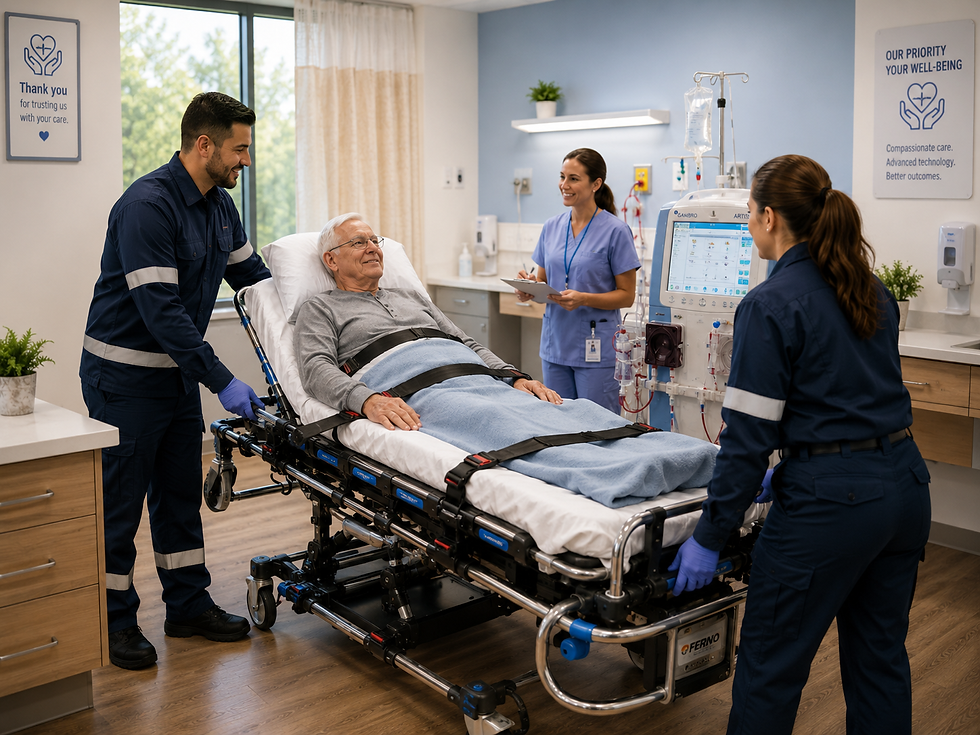
If any of that sounds familiar, the safer option is non-emergency stretcher transport — a service built for exactly this gap between an ambulance and a regular car. It's not just a vehicle with a stretcher in it. It includes two trained crew members who handle the transfer at both ends, so nobody in the family has to attempt a lift they're not equipped to do safely.
Booking with Aurevia
If you're not sure whether your loved one's situation calls for stretcher transport or whether a regular vehicle is still appropriate, we're happy to talk it through. When you call, we'll ask about their mobility, any positioning needs, and what's involved at both ends of the trip, then walk you through what makes sense.
Phone: 437-870-8090 | Monday to Sunday, 8am to 8pm
Aurevia Patient Transfers provides pre-scheduled, non-emergency stretcher transportation across Toronto and the Greater Toronto Area — hospital discharges, medical appointments, and facility-to-facility transfers.

Comments