Understanding Bariatric Services in Stretcher Transport

Updated: Jun 19
Aurevia Patient Transfers | Toronto & GTA
Families arranging bariatric stretcher transport are often working with two problems at once: finding a provider who can actually do the transfer safely, and finding one who will talk about it in a way that doesn't feel reducing or uncomfortable. Both matter. This article covers what bariatric stretcher transport actually involves, why a standard setup isn't always enough, and what to expect when you call.

What "bariatric" means here
In medical transport, "bariatric" simply describes a patient whose size or weight is beyond what standard equipment is built for — not a diagnosis, and not a judgment. It's an equipment and planning category, the same way "pediatric" describes a different set of equipment needs for a child. The term shows up in transport and healthcare contexts specifically because standard stretchers, vehicles, and lifting techniques have real physical limits, and going beyond them safely requires different tools and a different plan.
Why bariatric transport is its own category
A standard stretcher and a standard two-person crew are built around a typical range of size and weight. Bariatric patients fall outside that range, and a few things change as a result.
The equipment has to be rated for it. A bariatric stretcher is wider and built to safely support higher weight, with a frame and securing system designed for that load. Using a standard stretcher beyond its rated capacity isn't a minor risk — it's a real safety problem for the patient and the crew.
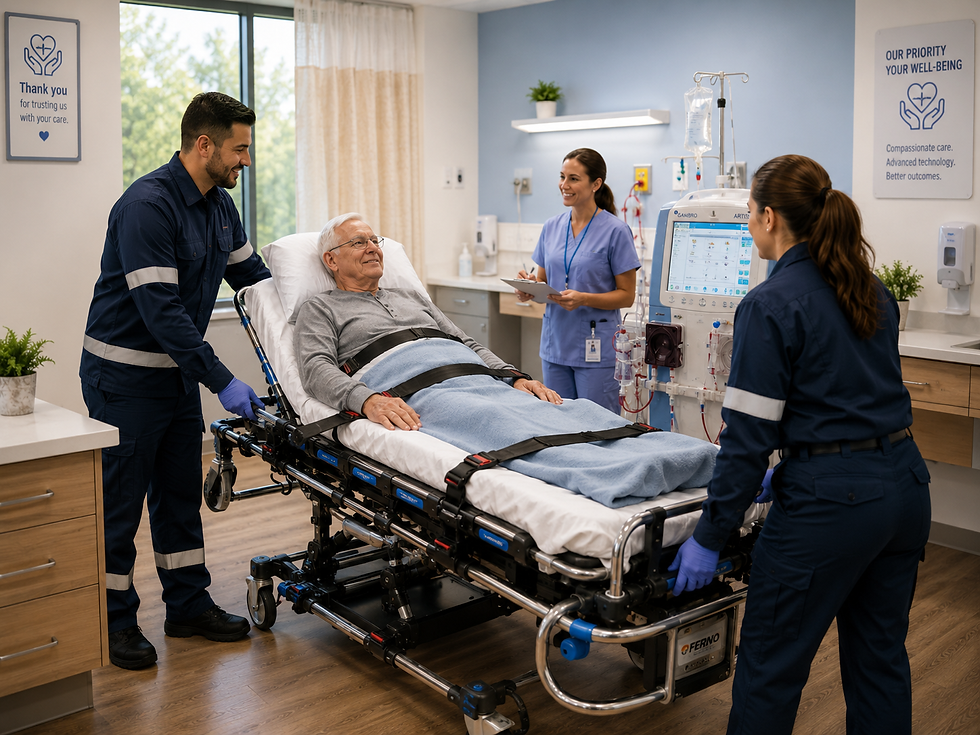
The transfer itself takes more planning. Moving someone safely from a bed onto a stretcher, through a building, and into a vehicle requires more than just a sturdier stretcher. It often calls for additional crew, different lifting technique, and more attention to doorway and hallway clearance than a standard transfer.
The vehicle and loading system need to handle it too. It's not just the stretcher — the ramp, loading mechanism, and securing points in the vehicle all need to be appropriate for the weight and dimensions involved.
A provider that hasn't planned specifically for bariatric transport isn't a safer or more economical choice. It's a provider that may not be able to complete the transfer at all, or will attempt it without the right equipment.
What matters beyond the equipment
Dignity matters as much as logistics here. Nobody wants to feel like a logistical problem to be solved, and the way a crew talks about the transfer — beforehand and during it — makes a real difference. A good crew treats a bariatric transfer the same way they'd treat any other: professionally, efficiently, and without making it the subject of conversation. The goal is a transfer that goes smoothly and unremarkably, the same as it would for anyone else.
How this gets handled when you call
Every bariatric case is reviewed individually before booking. That's not a formality — it's how we make sure the right equipment and crew configuration are in place before the day of the transfer, rather than discovering a mismatch on-site.
When you call, expect to be asked about:
General size and mobility. A rough sense of size and weight, and how much the person can assist with their own positioning, if at all.
Access at both ends. Doorway widths, hallway clearance, stairs, and elevator availability. These details affect what equipment and crew configuration make sense for the specific locations involved.
Positioning needs. Whether the person needs to remain flat, semi-elevated, or has other requirements based on their condition.
We'll work through these details before confirming the booking, so the crew that shows up is the right one for the transfer — not a standard setup that turns out not to fit.
Booking with Aurevia
We offer bariatric stretcher transport with the equipment and crew configuration needed for safe handling, reviewed case by case. When you call, we'll ask the questions above, walk through what's involved for your specific situation, and provide a complete, itemized quote before anything is confirmed.
Phone: 437-870-8090 | Monday to Sunday, 8am to 8pm
Aurevia Patient Transfers provides pre-scheduled, non-emergency stretcher transportation across Toronto and the Greater Toronto Area, including bariatric stretcher transport reviewed and configured for each individual case.
Comments